Verifying Borg Backups Daily - repository checks, archive validation, and live health dashboards across multi-cloud nodes.
The Problem
borgmatic has become one of those tools I almost take for granted. It quietly runs every night, backing up my entire fleet with incredible efficiency - routinely hitting 99%+ deduplication and keeping costs low at rsync.net.
I’ve never actually needed to restore anything major (thankfully), but the backups are there, my safety net.
That’s the catch - they’re only a safety net if they actually work.
What if an archive is corrupted? What if incremental changes introduce silent errors? What if the repository itself degrades over time? In a real disaster, discovering a backup is unrecoverable is the last thing anyone wants.
Most backup systems are "set and forget" - great until the moment you can’t forget anymore, and you actually need them.
The Solution
Borg ships with powerful built-in verification commands that most people (including me, until recently) rarely run:
borg check --repository-onlyvalidates the overall repository structureborg check --archives-onlyconfirms the integrity of individual archives (I check the last three)borg info --jsongives detailed stats on original, compressed, and deduplicated sizes
These checks are fast, non-destructive, and perfect for automation.
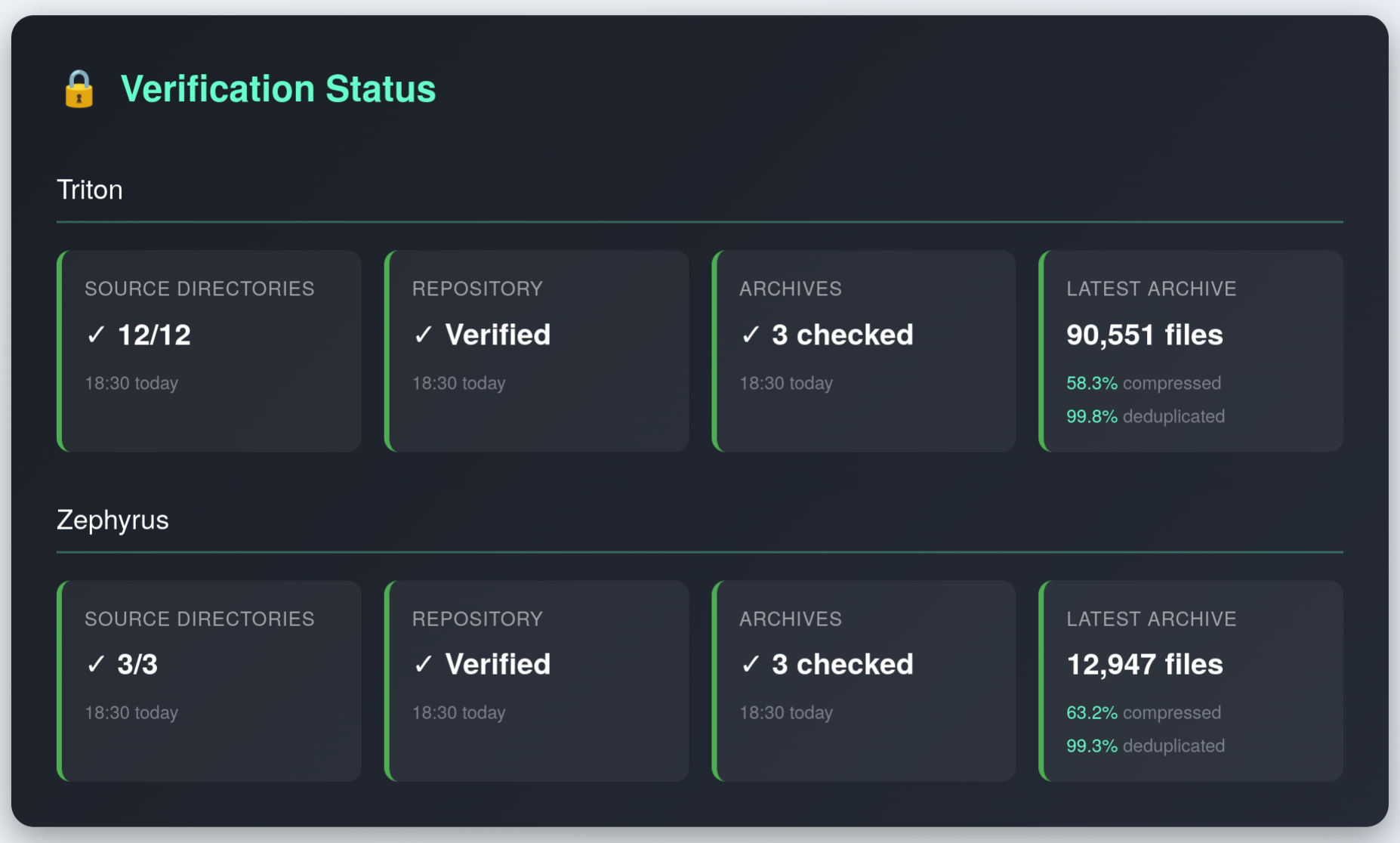
I built a lightweight Python pipeline that runs them daily across my nodes. The script parses the output, logs structured JSON, and feeds a live dashboard on backups.beane.me.
The result? Not just backups - proven recoverable backups, with real-time visibility into health and efficiency (including that near-magical 99.8% deduplication).
It took a focused sprint, but the peace of mind is priceless. I now know my safety net is intact, every single day.
Architecture Overview
                             ┌──────────────────────┐
                             │   rsync.net Repo     │
                             │ (encrypted Borg repo)│
                             └──────────^───────────┘
                                        │
                  ┌─────────────────────┼─────────────────────┐
                  │                                           │
   ┌──────────────┴──────────────┐               ┌────────────┴────────────────┐
   │       Triton Node           │               │       Zephyrus Node         │
   │                             │               │                             │
   │  Borgmatic (nightly backups)│               │  Borgmatic (nightly backups)│
   │                             │               │                             │
   │  verify_borgmatic.py        │               │  verify_borgmatic.py        │
   │   (daily: source check,     │               │   (daily: source check,     │
   │   repo integrity, archive   │               │   repo integrity, archive   │
   │   verification, stats)      │               │   verification, stats)      │
   └──────────────^──────────────┘               └──────────────^──────────────┘
                  │                                           │
                  │  verification_log.json (sanitized)        │
                  │                                           │
                  └──────────────> HTTP fetch <───────────────┘
                                        │
                                        ▼
                             ┌──────────────────────┐
                             │       Triton         │
                             │  html_update.py      │
                             │ (every hour: fetch   │
                             │ remote logs, render) │
                             └──────────^───────────┘
                                        │
                                        ▼
                             ┌─────────────────────┐
                             │   backups.beane.me  │
                             │   (live dashboard)  │
                             └─────────────────────┘
Implementation
For the core of the verification, we utilized the built-in borg check commands - first for a quick check, then to verify the integrity of the last 3:
# Repository structure check (fast)
borg check --repository-only $REPO

# Archive integrity for last 3
borg check --archives-only $REPO::$(borg list --last 3 --short $REPO)
Since we're aiming for full automation, the archive verification loop is written in Python.
def verify_borg_archives(repo: str, last_n: int = 3) -> dict:
    # List recent archives
    success, stdout, _ = run_command(["borg", "list", "--short", "--last", str(last_n), repo])
    archives = [line.strip() for line in stdout.strip().split('\n') if line.strip()]

    for archive_name in archives:
        success, _, _ = run_command(["borg", "check", "--archives-only", f"{repo}::{archive_name}"])
        # Log result
We can then extract the stats, which is how we got our dedupe number - a staggering 99.8% on one of the nodes - meaning only 0.2% of those backups are actually stored on disk!
info = json.loads(run_command(["borg", "info", "--json", f"{repo}::{latest_archive}"])[1])
stats = info['archives'][0]['stats']
compression_ratio = (1 - stats['compressed_size'] / stats['original_size']) * 100
dedup_ratio = (1 - stats['deduplicated_size'] / stats['compressed_size']) * 100
When we fetch our dashboard, we're able to use multi-node aggregation (since some JSON is stored locally, running on Triton, and other JSON is pulled remotely - currently on Zephyrus.
def fetch_remote_verification(url):
    log = requests.get(url).json()
    latest = {}
    for entry in reversed(log):
        if entry.get("check_type") not in latest:
            latest[entry["check_type"]] = entry
    return latest
$REPO is used rather than actual repo at rsync.net - just for sanitization.
Challenges
Even a "smooth" project like this had a few hurdles worth calling out - mostly around coordination, timing, and keeping things secure/scalable.
- Timing & Coordination Across Nodes
- Verification runs daily on each node at 30 minutes past midnight)
- The original HTML rendering script ran every 10 minutes, on the hour.
- Solution: Shift rendering to every hour at :40 (10 minutes after verification completes), giving the remote nodes time to finish and expose updated JSON.
- Secure Multi-Node Aggregation Without Credential Exposure
- Early idea: Rsync logs privately - blocked by no root SSH access from remote nodes.
- Final approach: Sanitize sensitive fields (repository path: "rsync.net (hidden credentials)") and expose logs publicly via HTTPS.
- Remote fetch in
html_update.pyprocesses them identically to local logs. Trade-off accepted: minimal exposure, maximum simplicity, and future scalability. - Parsing Borgmatic Config Safely
- Added robust fallbacks and warnings.
- Ensured passphrase handling never logs or exposes secrets.
- Keeping the Pipeline Lightweight
- Stuck to
--repository-onlyand--archives-onlyon the last 3 - quick metadata checks, no heavy data transfer. - Daily verification strikes the balance between early detection and courtesy to the provider.
The biggest practical challenge was ensuring the dashboard always showed fresh data, without race conditions.
I wanted centralized visibility but did not want to share Borg credentials, or SSH keys across nodes.
Extracting repo/path/passphrase automatically required careful YAML parsing - edge cases like missing keys or legacy formats could crash the script.
Borg checks are fast, but running full archive scans too frequently could burden rsync.net.
None of these were showstoppers; however, solving them cleanly made our system more robust and easier to extend to future nodes.
Results
Since launch (mid-December 2025), the verification pipeline has been running flawlessly across Triton and Zephyrus.
Key Metrics
- Verification Frequency: Daily (30 minutes past midnight - 00:30) - running now, with full automation and no failures.
- Check Coverage:
- Source directories: 12/12 (Triton), 3/3 Zephyrus consistently accessible
- Repository integrity: Verified every run
- Archives: Last 3 validated every run
- Efficiency Stats (from latest archive on Triton):
- 90,551 files backed up
- Original size: 2.37 GB
- Compressed: 1.01 GB (58.2% reduction)
- Deduplicated: 1.95 MB (99.8% deduplication)
Dashboard Impact
- Live at backups.beane.me
- Multi-node health cards update hourly
- Clear visual status (checkmark for verified, timestamps, compression/dedup ratios)
- No stale data - rendering shifted to :40 to sync with verification completion
Peace of Mind Bonus
- Early detection window: issues would surface same-day, not weeks later.
- Zero manual intervention required since deployment.
The pipeline didn't add checks - it turned backups from a background task into transparent, proven reliability.